Gaming Is the Answer... But I Can't Remember the Question: The Philosophy of Play in a Digital World
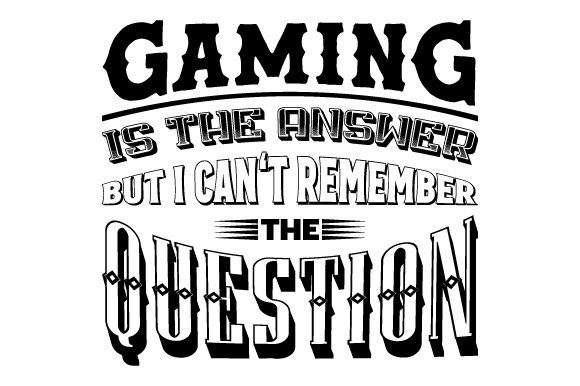
In a world saturated with notifications, deadlines, and constant demands, a simple phrase like "Gaming is the Answer... but I can't remember the question" can feel deeply resonant. It’s more than just a witty design for a T-shirt or a desktop wallpaper; it's a modern philosophical statement about the role of play, escape, and digital interaction in our lives. This article explores this idea from the ground up, unpacking its purpose, its significance in our contemporary culture, and why the act of gaming—whether on a console, PC, or mobile device—has become such a profound "answer" for so many people.
What Is the "Question" We're All Asking?
To understand why gaming might be the answer, we first need to consider the unspoken "questions" of modern existence. These are not literal queries but underlying human needs and pressures: How do I find relief from stress? Where can I experience achievement and progress? How can I connect with others in a meaningful way? Where do I go to simply have fun and forget my worries? Life in the 21st century, despite its technological wonders, can often feel fragmented and overwhelming. The "question," then, is the search for balance, joy, community, and a sense of control in a complex world.
Gaming, in its myriad forms, emerges as a direct response to these needs. It provides a structured environment where goals are clear, feedback is immediate, and social bonds can be forged through shared missions. When you load a game, you enter a space where the often ambiguous "questions" of daily life are temporarily replaced by specific, solvable challenges. This is the core of the statement's appeal.
The Purpose and Significance of Play
Play is not a frivolous human activity; it is a fundamental one. From children learning social rules through games to adults using strategy games to sharpen problem-solving skills, play serves crucial developmental and psychological functions. Digital gaming is simply the latest evolution of this ancient human practice. Its significance lies in its accessibility and scalability. Unlike a physical sport requiring specific location and equipment, a digital game can be a vast fantasy RPG, a quick five-minute puzzle on your phone, or a collaborative building project with friends across the globe—all serving that same primal need for engaged play.
In this context, the design offered in versatile formats like SVG, EPS, and PNG is itself a metaphor. The vector files (SVG and EPS) are scalable to any size without loss of quality. This mirrors how the concept of "gaming as an answer" scales to fit different lives. For a student, it might be an answer to boredom and a need for stimulation. For a busy professional, it's an answer to the need for a mental shutdown. For a retiree, it might be an answer to the search for new social circles. The design, like the idea, is adaptable.
Gaming in Modern Life: More Than Entertainment
The practical relevance of gaming extends far beyond mere entertainment. It is woven into the fabric of modern life, work, education, and creativity.
- In Daily Life & Mental Health: For many, gaming is a legitimate tool for mental decompression. Engaging in a well-designed game can induce a state of "flow," where worry and external stress fade in focus on the task at hand. This can be a healthy, managed form of escapism, similar to reading a novel or watching a film.
- In Work & Business: The principles of game design—clear objectives, reward systems, and progressive mastery—are increasingly applied to business software, employee training modules, and even marketing (gamification). The problem-solving and systems-thinking skills honed in complex games are directly transferable to many tech and analytical careers.
- In Education & Learning: Educational games make learning interactive and engaging. More fundamentally, the perseverance learned from overcoming a difficult game level—the "try, fail, learn, try again" loop—is a crucial mindset for any learning endeavor.
- In Creativity & Technology: Gaming is a pinnacle of interdisciplinary creativity, merging art, narrative, music, programming, and user-interface design. For players, games like sandbox or building games unleash creative potential, allowing them to construct worlds, solve problems ingeniously, or even create mods and new content.
Clarifying Common Misunderstandings
A prevalent assumption is that gaming is a passive, isolating, or purely childish activity. This is a misunderstanding that the phrase "Gaming is the Answer" indirectly challenges.
First, gaming is active. It requires decision-making, strategic thinking, and often physical coordination. Second, while it can be solitary, it is increasingly and profoundly social. Massive online communities, cooperative gameplay, and esports teams create strong social bonds. Third, the demographic of gamers spans all ages; the "answer" is relevant to anyone, not just youths. Recognizing gaming as a multifaceted, legitimate hobby is key to understanding its cultural weight.
The Digital Design as a Token of the Idea
The offered design—a vector graphic stating this philosophical motto—is a perfect example of how digital creativity and personal expression intersect with the idea. Receiving it as an Instant Digital Download in formats like SVG and EPS means you own a piece of adaptable art. You can scale it for a poster without pixelation, change its color from black to any hue you want using compatible software, and use it to represent your own perspective. This practicality mirrors the customizable, user-driven nature of gaming itself. You aren't just receiving a static image; you're receiving a tool for personal expression, much like a game provides a framework for personal experience and achievement.
Building a Broader Understanding: Gaming as a Cultural Lens
To see gaming solely as "the answer" to stress or boredom is to limit its scope. It is better understood as a cultural lens—a way to understand broader trends in technology, storytelling, and social interaction. The evolution of games from simple pixelated adventures to immersive, narrative-driven worlds reflects our advancing technological capabilities and our enduring desire for story. The rise of live-streaming and esports reflects new models of community and spectatorship. Gaming sits at the intersection of art, tech, commerce, and sociology.
Therefore, when we say "Gaming is the Answer," we might be speaking on several levels:
- The Personal Answer: A source of joy, challenge, and relaxation for the individual.
- The Social Answer: A platform for building friendships and collaborative communities that transcend geography.
- The Cognitive Answer: A tool for developing and exercising skills in logic, planning, and resource management.
- The Creative Answer: An outlet for imagination, both in playing within designed worlds and in creating content around them.
Conclusion: Embracing the Answer Without the Question
Perhaps the most beautiful part of the phrase "Gaming is the Answer... but I can't remember the question" is its implication of intuitive, unforced necessity. Sometimes, we don't need to analytically deconstruct our needs. Sometimes, we just need an activity that feels right—that provides satisfaction, connection, and engagement on a holistic level. Gaming, for millions, fulfills that role. It is an answer that arrived even before we could fully articulate the complicated, multifaceted questions of modern life.
Whether you display the design on a mug, a shirt, or your website, or simply embrace the concept, it serves as a reminder that in our digital age, play remains a vital, scalable, and profoundly human answer. And the formats it comes in—scalable vectors and adaptable PNGs—ensure the idea, just like a good game, can fit perfectly into your life, no matter what size or color you need it to be.